Thursday, 22 July 2010
Climate Change - still no evidence it's humans
It was an event so remarkable that it was almost lost on some people. Dr Phil Jones - the professor at the centre of the East Anglia CRU "Climategate" scandal - was allowed to approve which papers were used in evidence during some of the "independent" investigations into the scandal. It's a bizarre decision that seems equivalent to a robber approving which stolen items can be used as evidence in court. Then again, perhaps it's not all that surprising since one of the "independent" investigative bodies had the logo and email address of East Anglia University on their own logo.
But really, who cares? Who will notice? For most people, Climategate is old news. The casual current affairs observer read that some scientists got in trouble, they may have been lying about global warming but then a whole bunch of people checked and said they were fine. As for those already involved in such a fiercely polarised debate, well, they were never going to budge anyway. Sure enough, order was quickly restored as the whitewashing investigations did their job, the media went crawling back to every scientist who assured us climate change is real and the sceptics became the pantomime villains once again. Certainty was restored.
The only problem is, nobody seems to know: what we are supposed to be certain of? Next time you hear someone preaching about climate change, how serious it is and how we need to take action yesterday, ask them a few questions. Start with something easy such as: "What exactly are we certain is happening?". Most of them will mention Earth is getting warmer, the halfway smart ones will remember to mention something about co2 or anthropogenic activity.
Now ask a very slightly more informed questioned that cannot be answered with bluster, something like: "When was the last year that temperatures actually peaked?"(Answer: 1995) , follow that with a few more moderate queries like: "How much of the temperature rise is due to carbon dioxide?" (Nobody knows) "What is the hottest time period on record?" (Answer: The Medieval Warm Period) and so on. Before long they'll admit they don't know. You might even get called a 'denier' or some other insult for good measure. The reality is that most of us don't really know a great deal behind the science of climate change, but some of us like to pretend we do. In truth, we do as all generations have done and look to our finest minds to guide us in the esoteric ways of science. Therein lies the problem.
The Intergovernmental Panel on Climate Change (IPCC) are the multimillion dollar taxpayer-funded unit of scientific specialists who are responsible for researching, predicting and advising the rest of the world about global warming. With a huge amount of lobbying influence and a whole wealth of corporate interests flying around, we can surely be forgiven for expecting the unit to provide us with accurate, understandable and specific data about what's happening and what's going to happen. The reality is the exact opposite.
Predictions, warnings and forecasts from the IPCC ever since its inception in 1990 have been vague, wrong and contradictory to the point of resembling a tabloid astrologer's column. We've been warned over and over again of temperature increases that have not happened. We've been told the warming would first appear at the poles. Hot weather spells are due to global warming but snowfall is also a sign of the same thing. There will be more floods or hurricanes. Certain animals will become extinct, others will multiply by the horde. The extra co2 - required for respiration in plant life - will encroach the rainforest. It will create droughts, but extra rainfall is also a symptom. The surreal list goes on and on. Can we really blame the laymen for being unclear when this is what they are fed on?
The list of doomsday events such as extra natural disasters, melting poles and "unprecedented" (one of the IPCC's favourite and most overused words) heat are not random. They are designed to create fear, for fear is what keeps the taxpayers happy to part with their money for the nice scientists who will protect them.
But if you've lost any sleep about any of these nightmare-like events we've been warned about, go and get some shuteye right now. There is absolutely zero evidence that hurricanes, volcanoes or any other disaster has increased in frequency. In fact, they seem to have declined very slightly. The decline of the Arctic ice has received (ahem) extended interest from the media and the IPCC, both of whom neglect to mention that decline has been in trend since the end of the last Little Ice Age and is not accelerating. Meanwhile, the Antarctic ice is doing great. Funny, we don't hear about that.
As for "unprecedented" temperatures and the warnings from the likes of Al Gore that several of the last fifteen years have been the hottest on record, well it's just plain false. That's the reason alarmists hate to hear about the Medieval Warm Period.
Of course, none of this proves that AGW is false or a flawed theory, but it must surely prove to any sane person that even our supposed finest minds really don't know what is happening, to what extent it's happening or what will happen in the future. So why is there so much talk of a "consensus"? Could the multi-million dollar business interests of the IPCC have anything to do with it? Don't mistake this as a conspiracy theory. The only "conspiracy" you need to accept here is that powerful people will lie to get themselves rich. WMDs anyone? How about some MPs expenses on the side?
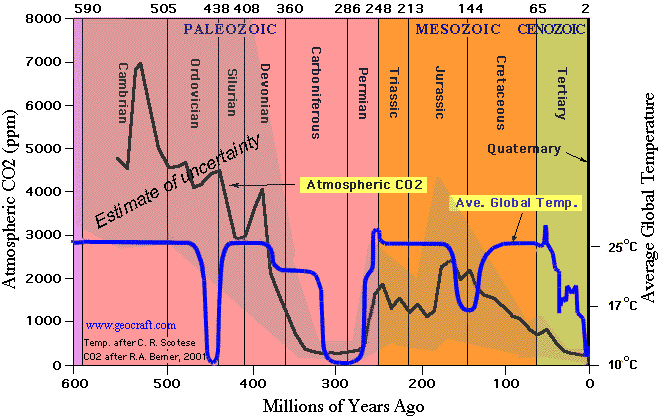
There's more reason to be sceptical. Huge parts of the AGW theory fall flat on their face. The theory clearly states that warming will appear in the troposphere, it isn't. It says that co2 will drive climate, in history the opposite has happened on a large scale. It states the sea levels should rise exponentially, they aren't. There's any number of examples where things simply aren't happening as they should be if the basic theory of increased radiative forcing generated by increased co2 emissions was straightforward and steadfast.
Perhaps the biggest slice of misinformation in this whole debate is the term used to describe scientists who oppose the mainstream opinion, the so-called 'deniers' - a term deliberately chosen for its disgusting undertones - is used to smear knowledgeable, qualified and good-natured people who dare to dissent. Very few scientists I have read from have denied the climate is changing, climate is always changing. What they dispute is the extent to which co2 plays a role in that change.
The theory of heat transference in the atmosphere is well established, but as we've seen, climate is a new and uncertain science with an incredible number of factors to consider; solar output, natural feedbacks, cloud feedback, continental shifts, astrophysics and more. A number of well-qualified scientists question if the increased co2 emissions will have any effect whatsoever. Many more believe that there will be an effect, but it will be far gentler than the IPCC suggest, and the trillions of dollars we will spend trying to cut temperatures by a minuscule percentage may be far better spent on reducing real pollution, researching cleaner energy, building hospitals or any other number of good causes. A layman 'denier' like me is inclined to agree.
Tuesday, 1 June 2010
The problem with the EDL
I do not pretend to be knowledgeable or even well informed about the English Defence League. The group were formed after I left the UK and the main source of detail I receive is from Facebook groups or minor newspaper articles.
However, even with such a trickle of knowledge, I had a hunch from very early on that there is more ton this group than meets the eye.
The EDL are clearly a defeatist party who will never gain mainstream acceptance. There is nothing new about this of course. Both sides of the political spectrum have small groups who want to live out some form of fantasy (think neo-Nazis or neo-Bolsheviks) and take pride on being outsiders, destined to be political losers forever. What seems to make the EDL different is the speed with which they have formed and become organised and the amount of attention they are receiving. The group are already organising marches around the nation, receiving lots of hits on their website and everyone involved in politics has an opinion on them. Compare this to the controversial BNP or even the National Front. Both groups took years to gain enough support to yield attention or concern.
Part of the reason for the EDL's appeal lies in the simplicity of their message. They're not a 'ballot box' political party, so they don't need to even pretend they have policies. Their focus is simple: march in support of the flag and against Islam. They do not have a racial agenda (though many on the left dispute this) and no political aspirations. If you're English, you're one of them. Or so they claim.
With immigration such a huge political issue at the moment and the government (new or old) appearing so weak in dealing with the failure of multiculturalism, the EDL's simple message reaches out to many disenchanted working class Brits who feel so betrayed by politicians and sick of political correctness. They are searching for a voice and they believe the EDL gives it to them.
But the problem is that a greatly simplified message will - for the most part - attract fairly simple people. It's no coincidence that the biggest reaction to the recent "Police are telling people in pubs they cannot wear England Shirts" hoax that did the rounds online and in the UK media came from EDL supporters. They took no time to consider the authenticity of the message or check any sources. They read it, so it must be true.
This is not a description of all EDL members and I'm sure many of them are more intelligent, qualified and wise than myself, but I think the majority of members fit my description.
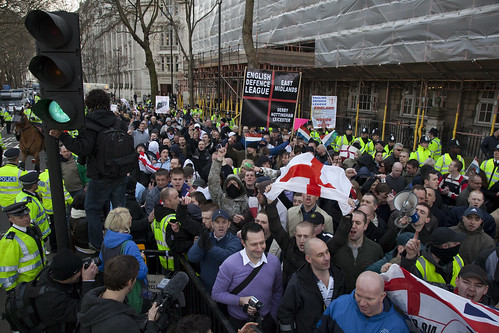
EDL marches paint a similar picture. So many shaved heads, hooded tops and angry faces play perfectly into the hands of their objectors or despicable groups like the UAF who seek any excuse to silence groups whom they dislike. There have been claims and accusations of widespread violence and anti-semitism on display at EDL marches. It should go without saying that if these claims are true, this is despicable. The problem is that however vehemently EDL staff deny these charges, people will always disbelieve them for the reasons mentioned above. They can't win.
With so much negative publicity and no apparent benefits from their existence, the obvious question is: Who is running the EDL? And to what purpose?
Sections of the left would claim the group is either a front-group or a militant section of the BNP or NF, often citing a few examples of far-right personnel who have joined the group. I think that's rubbish. The BNP have worked a long time to distance themselves from the 'football hooligan' image and have nothing to gain from setting up a group that achieves little more than a bunch of bad publicity. BNP Chairman Nick Griffin has also publicly criticised the group ins strong terms.
I think two far stronger possibilities exist. First - the EDL is run by a political party or person in a position of wealth or power on the left. This is not a conspiracy theory, it's simply a matter of realpolitik. The notions of patriotism, anti-Islam and groups like the BNP have been on the rise in recent years. Far-left groups have attempted to silence them and waves of politically correct politicians have attempted to stereotype them. For a long time it worked. But slowly society is waking up to the fact that opposing Islam is not racialist and patriotism is not inherently evil.
What better way to smash the growth of such sentiment than creating guilt by association? If you're against immigration or militant Islam you're just like those stupid hooligans marching and screaming in the street. In other words, you're a Fascist. And Fascists worked with Hitler.
The second possibility is that the EDL are a group designed to further split the right wing vote. After the BNP won a seat on the London Assembly, the government set about using new legislation to try and bankrupt the party, to whoops of delight from the "anti fascist" far-left. That failed. The idea of a party similar to the BNP in its message but at loggerheads with each other seems a perfect way to split votes and weaken the enemy. Again, if this sounds like conspiracy talk to you, ask yourself: what do you call it when a government grants itself new powers to bankrupt an opposing political party?
The other possibility is that the EDL is run by a coalition of far-right groups with the aim of creating fear and anxiety in certain areas for the purpose of enjoying violence and aggression. This is possible, but the level of funding, organisation and support seems to be out of their league.
Whatever the truth of the EDL, I want their well-meaning members - of which I'm sure we have many - to consider this: there is a good chance that the EDL is actually doing harm to every cause you stand for.
Leftists love nothing more than kidding themselves that nationalists of any type are stupid, gullible and inarticulate. It helps them to kid themselves they are smart. The government (any of the big three parties) love to portray opponents of immigration as uneducated, violent people, and the small proportion of Muslims who are militant love to portray EDL marches as 'Islamophobic' and 'hateful'
Yes, the growth of Islam in the UK is a massive concern. Yes, immigration (but not immigrants themselves) probably is a threat to our identity and way of life. Yes, political correctness is a cancer. And yes, the government have almost certainly encouraged all these things at the expense of the ethnic English. None of these facts justify support of the EDL. On the contrary, the reality of the problem is the reason why we should avoid such groups. A deeply complex problem should not be solved with a very simple yell of anger (at least, not without something else to go with it).
The real solution is this: study the problem, consider workable, genuine solutions to the problems. Decide which UK political party best suits your principles. UKIP and the English Democrats are both respected political parties with sensible policies to tackle immigration and protect traditional cultures.
Read bit more, learn about the inner workings of the political system, perhaps even become a candidate for your party. In short: tackle the enemy from within. It makes you so much harder to deal with.
One place to start wuld be the book "Saving England" by Vernon Coleman. Th ebook is short, easy to read and contains some good ideas.
EDL supporters, I repeat: if you care for any of the causes your group professes to support, my advice is to vent your passion in a very different way. The real defence of England does not lie with the EDL.
However, even with such a trickle of knowledge, I had a hunch from very early on that there is more ton this group than meets the eye.
The EDL are clearly a defeatist party who will never gain mainstream acceptance. There is nothing new about this of course. Both sides of the political spectrum have small groups who want to live out some form of fantasy (think neo-Nazis or neo-Bolsheviks) and take pride on being outsiders, destined to be political losers forever. What seems to make the EDL different is the speed with which they have formed and become organised and the amount of attention they are receiving. The group are already organising marches around the nation, receiving lots of hits on their website and everyone involved in politics has an opinion on them. Compare this to the controversial BNP or even the National Front. Both groups took years to gain enough support to yield attention or concern.
Part of the reason for the EDL's appeal lies in the simplicity of their message. They're not a 'ballot box' political party, so they don't need to even pretend they have policies. Their focus is simple: march in support of the flag and against Islam. They do not have a racial agenda (though many on the left dispute this) and no political aspirations. If you're English, you're one of them. Or so they claim.
With immigration such a huge political issue at the moment and the government (new or old) appearing so weak in dealing with the failure of multiculturalism, the EDL's simple message reaches out to many disenchanted working class Brits who feel so betrayed by politicians and sick of political correctness. They are searching for a voice and they believe the EDL gives it to them.
But the problem is that a greatly simplified message will - for the most part - attract fairly simple people. It's no coincidence that the biggest reaction to the recent "Police are telling people in pubs they cannot wear England Shirts" hoax that did the rounds online and in the UK media came from EDL supporters. They took no time to consider the authenticity of the message or check any sources. They read it, so it must be true.
This is not a description of all EDL members and I'm sure many of them are more intelligent, qualified and wise than myself, but I think the majority of members fit my description.
EDL marches paint a similar picture. So many shaved heads, hooded tops and angry faces play perfectly into the hands of their objectors or despicable groups like the UAF who seek any excuse to silence groups whom they dislike. There have been claims and accusations of widespread violence and anti-semitism on display at EDL marches. It should go without saying that if these claims are true, this is despicable. The problem is that however vehemently EDL staff deny these charges, people will always disbelieve them for the reasons mentioned above. They can't win.
With so much negative publicity and no apparent benefits from their existence, the obvious question is: Who is running the EDL? And to what purpose?
Sections of the left would claim the group is either a front-group or a militant section of the BNP or NF, often citing a few examples of far-right personnel who have joined the group. I think that's rubbish. The BNP have worked a long time to distance themselves from the 'football hooligan' image and have nothing to gain from setting up a group that achieves little more than a bunch of bad publicity. BNP Chairman Nick Griffin has also publicly criticised the group ins strong terms.
I think two far stronger possibilities exist. First - the EDL is run by a political party or person in a position of wealth or power on the left. This is not a conspiracy theory, it's simply a matter of realpolitik. The notions of patriotism, anti-Islam and groups like the BNP have been on the rise in recent years. Far-left groups have attempted to silence them and waves of politically correct politicians have attempted to stereotype them. For a long time it worked. But slowly society is waking up to the fact that opposing Islam is not racialist and patriotism is not inherently evil.
What better way to smash the growth of such sentiment than creating guilt by association? If you're against immigration or militant Islam you're just like those stupid hooligans marching and screaming in the street. In other words, you're a Fascist. And Fascists worked with Hitler.
The second possibility is that the EDL are a group designed to further split the right wing vote. After the BNP won a seat on the London Assembly, the government set about using new legislation to try and bankrupt the party, to whoops of delight from the "anti fascist" far-left. That failed. The idea of a party similar to the BNP in its message but at loggerheads with each other seems a perfect way to split votes and weaken the enemy. Again, if this sounds like conspiracy talk to you, ask yourself: what do you call it when a government grants itself new powers to bankrupt an opposing political party?
The other possibility is that the EDL is run by a coalition of far-right groups with the aim of creating fear and anxiety in certain areas for the purpose of enjoying violence and aggression. This is possible, but the level of funding, organisation and support seems to be out of their league.
Whatever the truth of the EDL, I want their well-meaning members - of which I'm sure we have many - to consider this: there is a good chance that the EDL is actually doing harm to every cause you stand for.
Leftists love nothing more than kidding themselves that nationalists of any type are stupid, gullible and inarticulate. It helps them to kid themselves they are smart. The government (any of the big three parties) love to portray opponents of immigration as uneducated, violent people, and the small proportion of Muslims who are militant love to portray EDL marches as 'Islamophobic' and 'hateful'
Yes, the growth of Islam in the UK is a massive concern. Yes, immigration (but not immigrants themselves) probably is a threat to our identity and way of life. Yes, political correctness is a cancer. And yes, the government have almost certainly encouraged all these things at the expense of the ethnic English. None of these facts justify support of the EDL. On the contrary, the reality of the problem is the reason why we should avoid such groups. A deeply complex problem should not be solved with a very simple yell of anger (at least, not without something else to go with it).
The real solution is this: study the problem, consider workable, genuine solutions to the problems. Decide which UK political party best suits your principles. UKIP and the English Democrats are both respected political parties with sensible policies to tackle immigration and protect traditional cultures.
Read bit more, learn about the inner workings of the political system, perhaps even become a candidate for your party. In short: tackle the enemy from within. It makes you so much harder to deal with.
One place to start wuld be the book "Saving England" by Vernon Coleman. Th ebook is short, easy to read and contains some good ideas.
EDL supporters, I repeat: if you care for any of the causes your group professes to support, my advice is to vent your passion in a very different way. The real defence of England does not lie with the EDL.
Wednesday, 19 May 2010
On lazy thinking and errors of logic
Did you know that all Muslims are willing suicide bombers? Or that all brown eyed people are bank robbers? Bet you weren't aware that eating food guarantees death within one hundred and fifty years?
The above statements are all of course, ridiculously untrue or in the case of the final question, deceptive in its composition. You probably caught on immediately to all three fallacies because they are purposely outrageous. Yet, sadly, many equally ridiculous errors of logic exist in both British and Thai society and spread every day.
To use a topical example, the activities of the red shirt protesters in Thailand - whom I do not support - have met with a whole number of sweepingly ignorant remarks and media reporting in recent weeks. With the attempted assassination last night of General Sah Deang ("red commander" , someone whom I dislike and disagree with) a whole wave of ignorant remarks has spread throughout Thai Facebook groups.
Let's take a look at a typical quote doing the rounds:
"They [the red shirts] deserve it. They caused so many problems. They've used bombs themselves, they've caused great inconvenience to most people and they want to destroy the Emerald Buddha"
The prejudices and false understanding of the red shirt movement has already been dealt with by myself here:
http://www.facebook.com/note.php?note_id=383745141572
...so let's now take a look at some of the logical fallacies going on here.
The first, easiest to spot and yet most common error we see here is the fallacy of biased sampling in the idea that "the red shirts used bombs". This is a reference to sporadic grenade attacks on one Skytrain station and government building in Bangkok. In both cases, a maximum of two people carried out the attack and there is absolutely zero evidence suggesting red shirts did it.
But let's suppose red shirts were responsible for the attacks. The number of red shirt protesters could be estimated at, say, fifteen thousand people. So even if we imagine the four attackers were red shirts, that would account for a grand total of 0.0265 of the group. I imagine that's a similar or even smaller ratio than that of suicide bomber Muslims, criminal homosexuals or blue eyed rapists, but imagine the outcry if we tried to push any of those statements into popular thought.
So why do people think in such an erroneous way? In part, it is simply lazy thinking and received wisdom, but popular media must also take a large part of the blame. The more an incident - especially a violent or scary incident - is reported, the greater precedence it takes in our minds. Often that precedence is out of proportion with all risk. For example, during the bird flu scare, lots of Thais avoided eating chicken after about three farmers tragically died of the illness. I doubt many of those people avoided travelling by motorbike despite the three hundred or more equally tragic road deaths that month.
But other fallacies exist. The statement ( "they've caused so much disruption" ) also contains the old 'two wrongs make a right' argument that is so prevalent in Thailand these days. This argument is popular because it is basically an excuse to release the bad side that we all have inside us, that side that enjoys revenge and suffering on people with dislike. In short it says: "These people have done something to upset me, so it's OK for me to enjoy watching them suffer."
I fall for it as much as anyone else. The problem with this argument of course is that as well as losing its user any kind of moral high ground, it can work backwards. Pretty much any religious, ethnic or political group in any country can claim to have been wronged by any other at some point in time. Does that allow us to sit back and smirk when some form of revenge takes place? If we use the TWMAR argument, where does it ever stop?
The final sentence: "they wanted to destroy the Emerald Buddha" contains several errors in one short sentence. In fact, this was a total government fabrication reported widely in the media (which again demonstrates the power of the media to control our thinking). Why was this nonsense made up? The first reason is known as: "poisoning the wells".
"Poisoning the wells" is not the same as an ad-hominem attack (which this sentence also contains) because the idea of 'poisoning the well' is not only to discredit the target, but to ensure that any claim or intention stated by the target in future is considered false. In our example case, this works because the Emerald Buddha is a revered building in Thailand and any attack on it would imply terrorism and a hatred of the nation.
The final error I will point out here is the appeal to authority. In the case the authority is the DSI (Department of Special Investigation) who made the claim of the attempted attack on the Emerald Buddha by red shirts. The fallacy goes like this - the DSI are specialists on crime, the DSI make a statement about the red shirts planning crime, so the statement must be true.
OK let me indulge in one more observation. I don't know the name for this error, but it is clear: "Red shirts and yellow shirts are as bad as each other". In short, because they are both political, they are both brightly coloured and both protest. Ergo, they are equally evil. This error of thinking is so obvious when laid out that I surely don't need to explain the poor logic. Yet, we hear such comments every day.
Here's a few other random examples of errors in logic or judgment. In some cases I have given examples and explanations.
1) The appeal to force.
If you don't agree with me, something scary will happen.
"If we don't use ID cards in the UK, then we won't catch terrorists."
2) Euphemisms
In my personal experience, when right wing groups are involved in any kind of conflict, it is "imperialism" "right wing violence" etc. When leftists do it its is "direct action" , "protests" "conflicts with authority" etc.
This works because usage of certain vocabulary can greatly alter our judgment of a situation.
3) Argument to false authority
Do not confuse this with the "argument to authority" which concerns someone who actually has some specialised knowledge on the topic. The false authority does not, though may pretend otherwise.
The head of the IPCC says anthropogenic global warming is real so many people believe it to be so. But this man is a train engineer, why do we allow him to make such a decision for us?
4) Lying or false sources
"The Loch Ness monster is real. It says so on the webssite I read." (that I created myself).
"It's real, I read it on wikipedia."
5) Appeal to personal charm.
"Ahisit and Obama are both young, smart looking and good speakers. Therefore, they are the best people to run their respective countries."
6) Distraction or changing the subject.
Student A: "Did you steal that money from my desk?"
Student B: "You're just saying that because you failed your exam last week!"
7) Appeal by anecdote
A favourite of British politicians and used by all three candidates in the Prime Ministerial debates. Personal anecdotes are effective because they put a personal and often lucid slant on things that can make the argument seem more powerful than it really is.
"A lot of British people are very happy about the ID cards. Last week I met a lovely, sweet elderly lady living in a small cottage who told me she wanted an ID card because....."
In the example above, the little sweet old lady can make us forget that the vast majority of people believe ID cards are wrong.
8) Argument from selective or limited experience
"Most Thai women dress like bar girls. I spent a week on Nana Plaza and that was all I saw" (selective or biased experience)
"Polish people love tennis. I met two Poles last week who bought tickets for Wimbledon" (Limited experience)
9) Weasel wording
http://www.weaselwords.com.au/
10) To be nominated by anyone who cares to do so!
The above statements are all of course, ridiculously untrue or in the case of the final question, deceptive in its composition. You probably caught on immediately to all three fallacies because they are purposely outrageous. Yet, sadly, many equally ridiculous errors of logic exist in both British and Thai society and spread every day.
To use a topical example, the activities of the red shirt protesters in Thailand - whom I do not support - have met with a whole number of sweepingly ignorant remarks and media reporting in recent weeks. With the attempted assassination last night of General Sah Deang ("red commander" , someone whom I dislike and disagree with) a whole wave of ignorant remarks has spread throughout Thai Facebook groups.
Let's take a look at a typical quote doing the rounds:
"They [the red shirts] deserve it. They caused so many problems. They've used bombs themselves, they've caused great inconvenience to most people and they want to destroy the Emerald Buddha"
The prejudices and false understanding of the red shirt movement has already been dealt with by myself here:
http://www.facebook.com/note.php?note_id=383745141572
...so let's now take a look at some of the logical fallacies going on here.
The first, easiest to spot and yet most common error we see here is the fallacy of biased sampling in the idea that "the red shirts used bombs". This is a reference to sporadic grenade attacks on one Skytrain station and government building in Bangkok. In both cases, a maximum of two people carried out the attack and there is absolutely zero evidence suggesting red shirts did it.
But let's suppose red shirts were responsible for the attacks. The number of red shirt protesters could be estimated at, say, fifteen thousand people. So even if we imagine the four attackers were red shirts, that would account for a grand total of 0.0265 of the group. I imagine that's a similar or even smaller ratio than that of suicide bomber Muslims, criminal homosexuals or blue eyed rapists, but imagine the outcry if we tried to push any of those statements into popular thought.
So why do people think in such an erroneous way? In part, it is simply lazy thinking and received wisdom, but popular media must also take a large part of the blame. The more an incident - especially a violent or scary incident - is reported, the greater precedence it takes in our minds. Often that precedence is out of proportion with all risk. For example, during the bird flu scare, lots of Thais avoided eating chicken after about three farmers tragically died of the illness. I doubt many of those people avoided travelling by motorbike despite the three hundred or more equally tragic road deaths that month.
But other fallacies exist. The statement ( "they've caused so much disruption" ) also contains the old 'two wrongs make a right' argument that is so prevalent in Thailand these days. This argument is popular because it is basically an excuse to release the bad side that we all have inside us, that side that enjoys revenge and suffering on people with dislike. In short it says: "These people have done something to upset me, so it's OK for me to enjoy watching them suffer."
I fall for it as much as anyone else. The problem with this argument of course is that as well as losing its user any kind of moral high ground, it can work backwards. Pretty much any religious, ethnic or political group in any country can claim to have been wronged by any other at some point in time. Does that allow us to sit back and smirk when some form of revenge takes place? If we use the TWMAR argument, where does it ever stop?
The final sentence: "they wanted to destroy the Emerald Buddha" contains several errors in one short sentence. In fact, this was a total government fabrication reported widely in the media (which again demonstrates the power of the media to control our thinking). Why was this nonsense made up? The first reason is known as: "poisoning the wells".
"Poisoning the wells" is not the same as an ad-hominem attack (which this sentence also contains) because the idea of 'poisoning the well' is not only to discredit the target, but to ensure that any claim or intention stated by the target in future is considered false. In our example case, this works because the Emerald Buddha is a revered building in Thailand and any attack on it would imply terrorism and a hatred of the nation.
The final error I will point out here is the appeal to authority. In the case the authority is the DSI (Department of Special Investigation) who made the claim of the attempted attack on the Emerald Buddha by red shirts. The fallacy goes like this - the DSI are specialists on crime, the DSI make a statement about the red shirts planning crime, so the statement must be true.
OK let me indulge in one more observation. I don't know the name for this error, but it is clear: "Red shirts and yellow shirts are as bad as each other". In short, because they are both political, they are both brightly coloured and both protest. Ergo, they are equally evil. This error of thinking is so obvious when laid out that I surely don't need to explain the poor logic. Yet, we hear such comments every day.
Here's a few other random examples of errors in logic or judgment. In some cases I have given examples and explanations.
1) The appeal to force.
If you don't agree with me, something scary will happen.
"If we don't use ID cards in the UK, then we won't catch terrorists."
2) Euphemisms
In my personal experience, when right wing groups are involved in any kind of conflict, it is "imperialism" "right wing violence" etc. When leftists do it its is "direct action" , "protests" "conflicts with authority" etc.
This works because usage of certain vocabulary can greatly alter our judgment of a situation.
3) Argument to false authority
Do not confuse this with the "argument to authority" which concerns someone who actually has some specialised knowledge on the topic. The false authority does not, though may pretend otherwise.
The head of the IPCC says anthropogenic global warming is real so many people believe it to be so. But this man is a train engineer, why do we allow him to make such a decision for us?
4) Lying or false sources
"The Loch Ness monster is real. It says so on the webssite I read." (that I created myself).
"It's real, I read it on wikipedia."
5) Appeal to personal charm.
"Ahisit and Obama are both young, smart looking and good speakers. Therefore, they are the best people to run their respective countries."
6) Distraction or changing the subject.
Student A: "Did you steal that money from my desk?"
Student B: "You're just saying that because you failed your exam last week!"
7) Appeal by anecdote
A favourite of British politicians and used by all three candidates in the Prime Ministerial debates. Personal anecdotes are effective because they put a personal and often lucid slant on things that can make the argument seem more powerful than it really is.
"A lot of British people are very happy about the ID cards. Last week I met a lovely, sweet elderly lady living in a small cottage who told me she wanted an ID card because....."
In the example above, the little sweet old lady can make us forget that the vast majority of people believe ID cards are wrong.
8) Argument from selective or limited experience
"Most Thai women dress like bar girls. I spent a week on Nana Plaza and that was all I saw" (selective or biased experience)
"Polish people love tennis. I met two Poles last week who bought tickets for Wimbledon" (Limited experience)
9) Weasel wording
http://www.weaselwords.com.au/
10) To be nominated by anyone who cares to do so!
Sunday, 9 May 2010
Reflections on elections
So as the back-room bargaining continues, we can begin to reflect on the election of 2010. So much commentary has - and will continue to be - poured onto the topic that I'd rather sum up my own views with a few bullet points:
1) One year ago David Cameron was the golden boy of UK politics. He was the next Tony Blair, leading the Conservatives to ridiculous leads in every opinion poll in every media channel. That the Conservatives failed to win a clear majority last week is an utter and abysmal failure on behalf of Cameron and his party. No matter how they dress it up, there is no other conclusion that can be made.
2) I worry about people in this country. How can we continue to vote for the two 'big' parties when it's so clear that they have no ideology, no differences and in any case wield no real control over our laws?. What is the point in getting so excited about electing a government that has very little power left in the days of the EU?
3) Just weeks ago, Clegg and Cameron were slinging mud at each other in a desperate bid to finish first in the polls. Two weeks later, they are talking about running the country together. It's all about money and power.
4) Logically, the Lib Dems and Labour should have far more in common than the Tories and Lib Dems. The fact that the latter pair still want to work together should be all the wake up call Conservative voters need.
5) Is it time for proportional representation? UKIP polled over 900,000 votes yet none of those voters will be represented in parliament. The Green Party got around 200,000 votes and have an MP.
I still desperately hope Clegg will make a deal with Labour and that deal will involve a referendum on PR. (A referendum on our sovereignty is out of the question, I gather) I have zero faith in Labour and little in the Lib Dems but if the Tories get what they deserve - a fifth term as opposition - that fallout could finally finish them and allow a real party to take their place.
Whatever happens next, we face tough times with an inexperienced and unstable parliament at the helm. I wish them luck.
1) One year ago David Cameron was the golden boy of UK politics. He was the next Tony Blair, leading the Conservatives to ridiculous leads in every opinion poll in every media channel. That the Conservatives failed to win a clear majority last week is an utter and abysmal failure on behalf of Cameron and his party. No matter how they dress it up, there is no other conclusion that can be made.
2) I worry about people in this country. How can we continue to vote for the two 'big' parties when it's so clear that they have no ideology, no differences and in any case wield no real control over our laws?. What is the point in getting so excited about electing a government that has very little power left in the days of the EU?
3) Just weeks ago, Clegg and Cameron were slinging mud at each other in a desperate bid to finish first in the polls. Two weeks later, they are talking about running the country together. It's all about money and power.
4) Logically, the Lib Dems and Labour should have far more in common than the Tories and Lib Dems. The fact that the latter pair still want to work together should be all the wake up call Conservative voters need.
5) Is it time for proportional representation? UKIP polled over 900,000 votes yet none of those voters will be represented in parliament. The Green Party got around 200,000 votes and have an MP.
I still desperately hope Clegg will make a deal with Labour and that deal will involve a referendum on PR. (A referendum on our sovereignty is out of the question, I gather) I have zero faith in Labour and little in the Lib Dems but if the Tories get what they deserve - a fifth term as opposition - that fallout could finally finish them and allow a real party to take their place.
Whatever happens next, we face tough times with an inexperienced and unstable parliament at the helm. I wish them luck.
Thursday, 15 April 2010
Trouble in Thailand - the complete idiot's guide
Thailand has been in the international spotlight yet again over the last few weeks as the latest round of political violence reached a head. The latest conflict is simply part of a cycle that threatens to continue for some years yet, until certain other events will either quash it, or take it to a whole new level.
Each time the violence is shown on international TV, well-meaning people ask me and my fellow expats: "Are you OK?" or "What exactly is going on over there?". The problem with the second question is that people, understandably, assume that ex-pats out here comprehend what's really happening and can explain it. Sadly this is a faulty assumption. Many expats are as ignorant and blinkered about the situation as anyone else.
Often, expats give the breakdown like this: "Red shirts want Thaksin back. They worship him and come down from the north to Bangkok to protest for a couple of hundred baht (about five dollars) per day." This typical statement has several obvious undertones - all red shirts are poor, weak minded and uneducated puppets. The yellow shirts meanwhile, "hate Thaksin and want to keep him out." This is true in itself, but still lacks great detail.
For those who wanted a little more insight, I will now try to summarise the political situation in Thailand as concisely as possible.
Thaksin Shinwatra came to power in 2001. In his election campaign, he promised to pay attention to the poorer people of Thailand from the northern regions. He pledged village funds, discounted consumer goods and agricultural loans.
Thaksin and his party ("Thai Rak Thai" or "Thais love Thais") won the election by a landslide, partly due to his dynamic campaign and partly due to the weak performance of the preceding Democrat government during the Asian Financial Crisis.
Upon taking office, it was revealed/alleged by the National Counter Corruption Commission that the brand new PM had concealed millions of baht in assets by transferring them to relatives and house workers. Thaksin described it as 'an honest mistake'.
In the build up to his trial, tremendous pressure was placed on the NCCC and Constitutional Court judges. Thaksin would walk to the courts in celebrity style and make grand speeches decrying the courts and implying they were out of touch and undemocratic. He won his case. Years later, one of the judges admitted he had "been placed under tremendous pressure and threats".
Over the next few years Thaksin introduced many schemes such as the 20 baht health care scheme, village banking scheme and the war on drugs. The latter was opened by a remarkable speech but ended in thousands of suspicious deaths, often involving shootouts between police and unproven suspects.
Other problems occurred. Thaksin and his party had such a strong grip on parliament that no real opposition could be mounted. Various laws sailed through the house that involved massive conflicts of interest. Thaksin formed, then dissolved, then formed, then dissolved again a telecommunications watchdog while promoting his very own phone company across the country. He fired the advertisers who had won the contract for the Bangkok Sky Train development project and gave the contract to his own son, he used his position as PM to gain contracts for his own company abroad. Most worryingly, the senate and the Election Commission appeared to offer very little scrutiny of the house. Many senators had the same surnames as members of Thaksin's party.
Media freedom also became a concern. One newspaper that became critical of him found themselves subject to an AMLO investigation.
But none of this was wholly different to previous governments, except in its scope and chokehold on power. Meanwhile, the TRT party took the unique step of actually keeping some pre-election promises. The health-care scheme, the village funding, the loans to farmers were all delivered.
As this happened, some high raking people including the head privy councilor and a former business colleague began to launch vocal attacks on Thaksin, who responded in kind. The ex-colleague formed a group known as the PAD, who later became known simply as the "yellow shirts" and began a public war of words and lawsuits with the PM, followed by street protests.
Initially their protests were peaceful. The PAD were formed mainly from Bangkok people who were more aware of Thaksin's corruption and less beneficial from his policies, that were aimed at the poorer people in the north. The regular Bangkok protests made Thaksin a PM in exile. Eventually, it opened the door for the coup.
Thaksin responded by dissolving parliament and calling an election, but all major parties announced a boycott. When the elections were done, just one single MP who was not from Thai Rak Thai was elected. The situation was described by His Majesty the King as "a mess" and he urged the courts to solve the problem. From that moment on, the courts - particularly the Constitutional Court - made several strong, key verdicts that had a huge effect on the nation.
The coup of 2003 was lead by general Sondhi, one of many officers who had been spurned by Thaksin in military promotions. The junta set up a special panel to investigate alleged corruption by Thaksin and his family and a new government, with a former general as PM, took over the parliament.
The government was, by all accounts, dismal. Their greatest failure was any effort to dispel Thaksin's popularity with the north-eastern people. As the election loomed, a controversial charge was filed against the Thai Rak Thai Party that involved retroactive application of law. The court found the party guilty of vote buying and dissolved the party, banning all executives from politics for ten years.
The response from the TRT party was to use its second string of members as a new executive, and to form a new party. The junta set a date for new elections and introduced a new constitution. The new document was given a lukewarm reception and passed through referendum, though it was rejected in northern provinces.
The new election was billed as the Democrat Party - popular in Bangkok and the south - against the new incarnation of Thaksin's party. The latter won. Samak Suntarajev was the new PM and Thaksin returned to Thai shores, vowing to clear his name.
Perhaps he became overconfident. The courts found his wife guilty of abuse of power and laid new charges against Thaksin. He and his wife jumped bail and left the country again. Shortly after, the second incantation of his part was yet again dissolved by the courts. The banning of executives tipped the balance of parliament and allowed Democrat Aphisit Vejajiva as PM. All this took place while the PAD yellow shirts hit the streets with protests more violent and intimidating than ever before, including the seizure of the airport.
Aphisit worked hard to win favour but those who supported the ousted TRT party formed the 'red shirt' group and began their own protests. During the song kran festivals of 2009, the red shirts were spurned on by calls to 'bring down the elite' and rioted in Bangkok. One big target of their anger was Privy Councilor Prem Timsoland, who had served as chief of the privy council for many years and is considered to be very close to His Majesty The King.
The Aphisit government managed to dispel the protests and the courts began a case against Thaksin to seize assets of his frozen in Thai accounts. The verdict was reached about three months ago and some fifty billion baht of assets were taken from the ex-PM. Soon after, the red shirt groups promised the 'biggest rally ever' which lead to the events of the last few weeks.
There is another, crucial - perhaps the most crucial - aspect to all this that I cannot discuss. Two editions of 'The Economist' were banned from Thailand last year as was a book by Paul Handley for discussing the same sensitive topics. A google search for "Thailand's succession" may provide further research detail in this area.
How this saga will end is both difficult to assess for the reason mentioned above and also depressing to consider, with no end to the polarisation in sight and those in political power seeking only to exploit the situation for their own gain. What is clear however, is that some of the stereotypes and simplifications applied by Thai and foreigners alike to the situation are at best, lazy and, at worse, stupid.
It is true red shirted protesters mostly come from low income areas with lower standards of education. The Oxford University educated Aphisit Vejajiva of the Democrat Party has had over a year to win the hearts and minds of those in the north, and has failed to do so. Many of them want Thaksin back not because they worship him, but because for all his many faults, he actually had some benefit to people who live on sums of cash that many foreigners could never manage to live off, let alone support an entire family. Far from being foolish puppets of propaganda, most red shirts know exactly where their bread is buttered and are fighting for what is best for them, at least in the short term.
Moreover, the reds have a justified complaint. A government elected by a popular democratic vote has been overturned not once, but twice, in highly disputed circumstances. Meanwhile, the ruling Democrat Party were not even charged with a accepting an illegal donation until the same protesters stormed the Election Commission and demanded it happen.
Likewise, the yellow shirt PAD protesters had a full manifesto for change that went well beyond lynching Thaksin. Sadly, that detail was lost in the chaos of the violent actions taken by the group, who went on to form their own political party.
This is the briefest summary possible. Far more people, events and history have gone into making this saga. If you want to learn more, a few of these books may help:
Thaksin - the Business of Politics in Thailand - Pasuk and Baker
The Thaksinization of Thailand - Duncan McCargo
A Coup for the Rich? - Giles Ungpakorn
A political History of Thailand
The King Never Smiles - Paul Handley
Each time the violence is shown on international TV, well-meaning people ask me and my fellow expats: "Are you OK?" or "What exactly is going on over there?". The problem with the second question is that people, understandably, assume that ex-pats out here comprehend what's really happening and can explain it. Sadly this is a faulty assumption. Many expats are as ignorant and blinkered about the situation as anyone else.
Often, expats give the breakdown like this: "Red shirts want Thaksin back. They worship him and come down from the north to Bangkok to protest for a couple of hundred baht (about five dollars) per day." This typical statement has several obvious undertones - all red shirts are poor, weak minded and uneducated puppets. The yellow shirts meanwhile, "hate Thaksin and want to keep him out." This is true in itself, but still lacks great detail.
For those who wanted a little more insight, I will now try to summarise the political situation in Thailand as concisely as possible.
Thaksin Shinwatra came to power in 2001. In his election campaign, he promised to pay attention to the poorer people of Thailand from the northern regions. He pledged village funds, discounted consumer goods and agricultural loans.
Thaksin and his party ("Thai Rak Thai" or "Thais love Thais") won the election by a landslide, partly due to his dynamic campaign and partly due to the weak performance of the preceding Democrat government during the Asian Financial Crisis.
Upon taking office, it was revealed/alleged by the National Counter Corruption Commission that the brand new PM had concealed millions of baht in assets by transferring them to relatives and house workers. Thaksin described it as 'an honest mistake'.
In the build up to his trial, tremendous pressure was placed on the NCCC and Constitutional Court judges. Thaksin would walk to the courts in celebrity style and make grand speeches decrying the courts and implying they were out of touch and undemocratic. He won his case. Years later, one of the judges admitted he had "been placed under tremendous pressure and threats".
Over the next few years Thaksin introduced many schemes such as the 20 baht health care scheme, village banking scheme and the war on drugs. The latter was opened by a remarkable speech but ended in thousands of suspicious deaths, often involving shootouts between police and unproven suspects.
Other problems occurred. Thaksin and his party had such a strong grip on parliament that no real opposition could be mounted. Various laws sailed through the house that involved massive conflicts of interest. Thaksin formed, then dissolved, then formed, then dissolved again a telecommunications watchdog while promoting his very own phone company across the country. He fired the advertisers who had won the contract for the Bangkok Sky Train development project and gave the contract to his own son, he used his position as PM to gain contracts for his own company abroad. Most worryingly, the senate and the Election Commission appeared to offer very little scrutiny of the house. Many senators had the same surnames as members of Thaksin's party.
Media freedom also became a concern. One newspaper that became critical of him found themselves subject to an AMLO investigation.
But none of this was wholly different to previous governments, except in its scope and chokehold on power. Meanwhile, the TRT party took the unique step of actually keeping some pre-election promises. The health-care scheme, the village funding, the loans to farmers were all delivered.
As this happened, some high raking people including the head privy councilor and a former business colleague began to launch vocal attacks on Thaksin, who responded in kind. The ex-colleague formed a group known as the PAD, who later became known simply as the "yellow shirts" and began a public war of words and lawsuits with the PM, followed by street protests.
Initially their protests were peaceful. The PAD were formed mainly from Bangkok people who were more aware of Thaksin's corruption and less beneficial from his policies, that were aimed at the poorer people in the north. The regular Bangkok protests made Thaksin a PM in exile. Eventually, it opened the door for the coup.
Thaksin responded by dissolving parliament and calling an election, but all major parties announced a boycott. When the elections were done, just one single MP who was not from Thai Rak Thai was elected. The situation was described by His Majesty the King as "a mess" and he urged the courts to solve the problem. From that moment on, the courts - particularly the Constitutional Court - made several strong, key verdicts that had a huge effect on the nation.
The coup of 2003 was lead by general Sondhi, one of many officers who had been spurned by Thaksin in military promotions. The junta set up a special panel to investigate alleged corruption by Thaksin and his family and a new government, with a former general as PM, took over the parliament.
The government was, by all accounts, dismal. Their greatest failure was any effort to dispel Thaksin's popularity with the north-eastern people. As the election loomed, a controversial charge was filed against the Thai Rak Thai Party that involved retroactive application of law. The court found the party guilty of vote buying and dissolved the party, banning all executives from politics for ten years.
The response from the TRT party was to use its second string of members as a new executive, and to form a new party. The junta set a date for new elections and introduced a new constitution. The new document was given a lukewarm reception and passed through referendum, though it was rejected in northern provinces.
The new election was billed as the Democrat Party - popular in Bangkok and the south - against the new incarnation of Thaksin's party. The latter won. Samak Suntarajev was the new PM and Thaksin returned to Thai shores, vowing to clear his name.
Perhaps he became overconfident. The courts found his wife guilty of abuse of power and laid new charges against Thaksin. He and his wife jumped bail and left the country again. Shortly after, the second incantation of his part was yet again dissolved by the courts. The banning of executives tipped the balance of parliament and allowed Democrat Aphisit Vejajiva as PM. All this took place while the PAD yellow shirts hit the streets with protests more violent and intimidating than ever before, including the seizure of the airport.
Aphisit worked hard to win favour but those who supported the ousted TRT party formed the 'red shirt' group and began their own protests. During the song kran festivals of 2009, the red shirts were spurned on by calls to 'bring down the elite' and rioted in Bangkok. One big target of their anger was Privy Councilor Prem Timsoland, who had served as chief of the privy council for many years and is considered to be very close to His Majesty The King.
The Aphisit government managed to dispel the protests and the courts began a case against Thaksin to seize assets of his frozen in Thai accounts. The verdict was reached about three months ago and some fifty billion baht of assets were taken from the ex-PM. Soon after, the red shirt groups promised the 'biggest rally ever' which lead to the events of the last few weeks.
There is another, crucial - perhaps the most crucial - aspect to all this that I cannot discuss. Two editions of 'The Economist' were banned from Thailand last year as was a book by Paul Handley for discussing the same sensitive topics. A google search for "Thailand's succession" may provide further research detail in this area.
How this saga will end is both difficult to assess for the reason mentioned above and also depressing to consider, with no end to the polarisation in sight and those in political power seeking only to exploit the situation for their own gain. What is clear however, is that some of the stereotypes and simplifications applied by Thai and foreigners alike to the situation are at best, lazy and, at worse, stupid.
It is true red shirted protesters mostly come from low income areas with lower standards of education. The Oxford University educated Aphisit Vejajiva of the Democrat Party has had over a year to win the hearts and minds of those in the north, and has failed to do so. Many of them want Thaksin back not because they worship him, but because for all his many faults, he actually had some benefit to people who live on sums of cash that many foreigners could never manage to live off, let alone support an entire family. Far from being foolish puppets of propaganda, most red shirts know exactly where their bread is buttered and are fighting for what is best for them, at least in the short term.
Moreover, the reds have a justified complaint. A government elected by a popular democratic vote has been overturned not once, but twice, in highly disputed circumstances. Meanwhile, the ruling Democrat Party were not even charged with a accepting an illegal donation until the same protesters stormed the Election Commission and demanded it happen.
Likewise, the yellow shirt PAD protesters had a full manifesto for change that went well beyond lynching Thaksin. Sadly, that detail was lost in the chaos of the violent actions taken by the group, who went on to form their own political party.
This is the briefest summary possible. Far more people, events and history have gone into making this saga. If you want to learn more, a few of these books may help:
Thaksin - the Business of Politics in Thailand - Pasuk and Baker
The Thaksinization of Thailand - Duncan McCargo
A Coup for the Rich? - Giles Ungpakorn
A political History of Thailand
The King Never Smiles - Paul Handley
Wednesday, 14 April 2010
The real party list
With the election coming up and with the importance of not voting Conservative the overriding factor for people like myself. What are the other options available?
Here's a quick summary of parties that I think are worth the time of day.
UKIP
Good points: Good policies - Nuclear energy, EU referendum, five year freeze on immigration, etc. Are a party most people know about. Already have one MP and several MEPs.
Weak points: Widely believed to have had a few dodgy transactions within the party and new leader Lord Pearson made several expenses claims that, while not illegal, certainly appeared greedy and unnecessary
English Democrats:
Good points: A well known, well designed party. The mayor of Doncaster, Peter Davies is an English Democrat and a living legend.
Weak points: Not a unionist party. Manifesto is somewhat vague.
Popular Alliance:
Good points: The best, most detailed, researched and effective policies you will find in any party, period.
Weak points: We just don't have enough members to make a real impact.
Jury Team:
Good points: Nice website, well designed policies.
Weak points: Policies while good, are brief. The idea and system within the party may confuse some people.
Christian Party:
Good points: A good, well spoken and articulate leader. Excellent policies. Because of the Christian angle, the party actually tries to keep its promises.
Weak points: Being a Christian party obviously limits its appeal.
Traditional Democrats:
Good points: The party website clearly explains the benefit and relevance of conservative policies to a modern Britain.
Weak points: Given that I had to trawl through the Election Commission's party list to find these guys, they don't seem to be very good at promoting themselves.
Other parties worth a look: Veritas, Impact Party, Common Sense Party, Imperial Party.
Remember, the real battle this year is true conservatives against the Conservative Party. It's far more important not to vote for the wrong party as it is to vote for the party that's right for you.
Here's a quick summary of parties that I think are worth the time of day.
UKIP
Good points: Good policies - Nuclear energy, EU referendum, five year freeze on immigration, etc. Are a party most people know about. Already have one MP and several MEPs.
Weak points: Widely believed to have had a few dodgy transactions within the party and new leader Lord Pearson made several expenses claims that, while not illegal, certainly appeared greedy and unnecessary
English Democrats:
Good points: A well known, well designed party. The mayor of Doncaster, Peter Davies is an English Democrat and a living legend.
Weak points: Not a unionist party. Manifesto is somewhat vague.
Popular Alliance:
Good points: The best, most detailed, researched and effective policies you will find in any party, period.
Weak points: We just don't have enough members to make a real impact.
Jury Team:
Good points: Nice website, well designed policies.
Weak points: Policies while good, are brief. The idea and system within the party may confuse some people.
Christian Party:
Good points: A good, well spoken and articulate leader. Excellent policies. Because of the Christian angle, the party actually tries to keep its promises.
Weak points: Being a Christian party obviously limits its appeal.
Traditional Democrats:
Good points: The party website clearly explains the benefit and relevance of conservative policies to a modern Britain.
Weak points: Given that I had to trawl through the Election Commission's party list to find these guys, they don't seem to be very good at promoting themselves.
Other parties worth a look: Veritas, Impact Party, Common Sense Party, Imperial Party.
Remember, the real battle this year is true conservatives against the Conservative Party. It's far more important not to vote for the wrong party as it is to vote for the party that's right for you.
Monday, 22 March 2010
Sports and homphobia
Who you calling a wimp?
An article in my local paper caught my eye this weekend. Apparently a prominent rugby player named Gareth Thomas announced he was gay and a few months later, returned to the sport. Well done that man.
I've never understood some of my colleagues' objections to homosexuality. They (those against) can usually be divided into two types - religious and/or moral objectors and those with personal fears. The former profess to base their objections upon instruction from The Bible and refuse to believe people are born gay. In fact, I usually find arguments from this crowd boil down to dogma - The Bible is against homosexuality, so to accept that people are naturally gay is to accept that The Bible's divine instruction (i.e. God) is deliberately disobeyed by, well, God himself. In other words, it's a clear paradox and Christians and other religious groups must avoid it or face some awkward truths.
The second group often produce quotes such as: "It's just not normal for people to do that" or "These people have some disease" etc. Often these are the same people who have tattoos, take alcohol and nicotine into their bodies and a s a result suffer from colds or other illnesses. Nothing unnatural or ill about them, then! (And of course, homosexuality is not any kind of disease).
My favourite line from homophobics when they talk about gay men is is: "Just don't let him try to do anything with me" because this warning normally comes from the ugliest, sweatiest person you can imagine.
As a heterosexual person (I mention this to be clear I am not biased), my attitude is that homosexuals do not create more crime, do not put any extra strain on the tax payer and are not any less productive or honest members of society than the next Joe Public, so why give them any trouble? It may be true that certain illnesses or prescribed medications are attributed to the gay community at slightly higher rates, but this surely fades in comparison to the number of 'breeders' (as gay people playfully call us) who claim every single penny of child benefit that they can.
So with that in mind, let me be clear when I say one thing: I do not like gay pride festivals and marches, and other forms of 'advertising' a person's sexuality. My reasons for this are twofold: firstly, I find that usually, when a person feels a desperate need to tell us about certain aspects of their own private life, it's down to insecurity. The more we make a song and dance (literally, in the case of Gay Pride marches) about such things, the more we blow up that bubble of insecurity. It's emotional quicksand - the more I say 'look at me! I'm gay!" the more people think I must be different, the more different I feel, the more I need to shout about it, etc.
The second reason is more straightforward - I don't care what a stranger's sexual preference is, I just believe it's wrong to throw it around in public. I don't want to see woman on woman, woman on man or man on man action in broad daylight when anyone - including children - can be passing by.
That's not a conservative or outdated attitude and if anyone thinks it is, it's probably a sign of how evilly 'liberal' our society has become: if you object to people making out wherever and whenever they want, you must have something wrong with you.
That's not to say gays or anyone else can't get wild. I've been to gays clubs and had a great time just as I do at any other club. It's indoors, everyone inside is an adult.
The reason then that I applaud Gareth's announcement despite my usual attitude to sexual self-aggrandisement is that the world of sports is still loaded with prejudice and idiocy towards homosexuality.
My most vivid memory of this attitude is a football match between Southampton and Arsenal several years back. Back then, there was a widespread rumour that a certain Southampton player was gay, and halfway through the second half the entire section of visiting Arsenal fans began to chant :"(Player) is a homosexual" non-stop for about twenty minutes. Even as a kid at the time, I remember being struck by how callous and cruel fans must be to behave like that. It's one thing to banter, insult and try to distract a player on the opposition, but this was just plain vindictive.
Thomas' announcement was not aimed at championing himself, indeed he called for more sportsmen to 'come out' to help wash away tides of idiots. I support him in this action, the more players that come forward, the harder it is for idiots to bully them. But it must be incredibly difficult for any gay sports stars considering going public. In these early days, coming out of the closet could be damaging to their career, as well as an incredible mental strain.
But come out they must, for this is the only way to tackle the problem. The government, as usual, is going about things completely the wrong way by attempting to impose yet more mind control. This year it officially becomes illegal to make homophobic chants at football matches. All this shows us is that the people in power have no answer to the problem, no way to reach out to people and no hope of achieving their goal.
Think back to my experience at the Southampton Vs Arsenal game. If that happened now, would the police really wade in and arrest a few hundred people? Would it solve anything? Would it make the victimised player feel better? Would it keep the rest of the crowd safe? The answer to all these questions is surely obvious. The way to eradicate homophobia in sports and society, less so.
*************
Photo credit: http://www.rwc2007.irb.com
Subscribe to:
Posts (Atom)